Physician-Assisted Suicide and the De-Medicalization of Palliative Care

As the Yale Summer Bioethics Institute comes to a close, I have continued to contemplate and process some of the more prominent lectures featured in the program. One talk that I found particularly intriguing was Dr. Sherwin Nuland’s lecture on the importance of the “goodness of the physician” in caring for patients. Much of Nuland’s lecture focused on the history of the patient-physician relationship and how it has grown more distant through medical culture’s increasing emphases on scientific and technological progress. While calling for an overall restoration of the physician-patient relationship as a priority for healing, Nuland stated specifically regarding end-of-life care:

“When the time comes, personal, spiritual, and emotional leave-taking need surroundings of serenity, which are not to be found in the highly charged atmosphere of a bustling modern hospital. They also need a decision by all concerned that further efforts at rescue should not be attempted. This may require forceful determination on the part of patient and family; a careful and informed use of advanced directives; referral to the expert care of a hospice unit; the services of physicians and nurses skilled in palliative care; the intercession of an advocate; or the presence of a humane and empathetic family doctor or general internist. These are the ingredients that help create the aura of tranquility in which the act of accompanying can be fulfilled.”

Considering his arguments for humane and empathetic palliative care, I was interested in hearing Nuland’s opinions on the morality of arguments for and against a particularly controversial issue in end-of-life care—physician-assisted suicide. In a follow-up phone call, I asked the proceeding questions:

1) Would you say there is any relationship between the “goodness” of the physician that you discussed in your lecture and the idea of facilitating suicide for suffering patients?

2) What does the desire of some patients for physician-assisted suicide reflect about the state of palliative care? Should physician-assisted suicide become a regular option for palliative care providers, or should it be avoided and used only as a last resort?

Dr. Sherwin Nuland lecturing at the Yale Summer Bioethics Institute.

Dr. Sherwin Nuland lecturing at the Yale Summer Bioethics Institute.

Nuland prefaced his answers to my questions with the disclaimer that such questions are far more complex than they appear. “The very goodness of the physician,” he stated, may cause him to take a stance on either side of the debate.  Physicians on one side of the debate might say, “My personal morality does not allow me to facilitate the death of another human being.” On the other hand, those who oppose physician-assisted suicide could make the alternative moral argument, “A good person cannot bear to watch the suffering of another human being that he cannot alleviate.” Good people are on both sides of the debate, Nuland concluded. Furthermore, goodness may also lead to uncertainty and cause a physician to look at both sides of the debate and say, “I don’t know.” And it is not wrong to be uncertain about such a weighty issue, he qualified—medical training is, in fact, largely a matter of preparing for events of uncertainty.

In response to my second question, Nuland pointed out that there is a significant difference between physician-assisted suicide “legislated correctly” and the laws that currently allow physician-assisted suicide in certain states. “These laws are very deficient,” he stated. Not only do the current laws in Oregon, Vermont, and Washington fail to “provide enough safeguards;” they also fail to insist that only the “right” people are getting the procedure. Nuland suggests that proper legislation be enacted to ensure consultation with both psychiatric specialists and family members before physicians can prescribe lethal drugs.

Moreover, Nuland observed critically that while he is not personally opposed to physician-assisted suicide, “an awful lot of proponents of physician-assisted suicide don’t know the first thing about palliative care.” One of the main problems with the current medical system for end-of-life care, he stated, is the severe shortage of palliative care physicians in the United States. And statistics stand to support his point—according to the American Academy of Hospice and Palliative Medicine, “there is only one specialist for every 20,000 older adults living with severe chronic illness.”

Nuland’s emphasis on making palliative care available to the chronically ill held consistent with the concluding words of his lecture, words characterized both by earnest censure and by a confident sense of hope toward end-of-life care: “Ways must be found to de-medicalize the final weeks or days, to nurture the dying and those who love them, and by this means to nurture ourselves. The real truth of healing lies in the nurture.”

Posted in Uncategorized | Tagged , , , , , , , , , | Leave a comment

Elderly “Reflections” Photo Series by Tom Hussey

The video blog FStoppers recently featured a 2010 series by photographer Tom Hussey entitled “Reflections.” With incredible realism, Hussey’s series portrays elderly individuals  studying mirror images of their younger selves in symbolic reminiscence. According to the Huffington Post, “The photographer arrived upon the concept for his bittersweet series after a conversation with an 80-year-old World War II veteran who couldn’t believe how quickly time had passed.” The photo series was also recognized in the American Society of Media Photographers’ “Best of 2010,” in an article that explained Hussey was commissioned by the advertising company AgencyRx and their pharmaceutical client Novartis to create the series “in a nod to the persistence of vision.” Hussey’s series not only made for a successful advertising campaign, with full-page photos printed in the pharmaceutical company’s brochures; it also resonates as a work of art—a deeply moving portrayal of the phenomenon of aging and coming to terms with the universal forward-moving motion of life.

The full photo series can be viewed on Tom Hussey’s website under the “Series”–>”Reflections” tabs.

Posted in Uncategorized | Tagged , , , , , , , , , , | Leave a comment

Profile of Palliative Care Chaplaincy: Q&A with Reverend Jane Jeuland

Reverend Jane Jeuland, palliative care chaplain at the Yale-New Haven Hospital

Reverend Jane Jeuland, palliative care chaplain at the Yale-New Haven Hospital

June 25  interview with Reverend Jane Jeuland, a palliative care chaplain at the Yale-New Haven Hospital in New Haven, CT. The answers recorded below were offered by Rev. Jeuland in her own words regarding her experiences in hospital chaplaincy.

To start us off, can you provide a general description of your job and the responsibilities it entails?

As chaplains in the hospital, our responsibility really boils down to meeting people where they are and offering spiritual support. Chaplains do not impose our personal faith traditions onto people and offer answers to these questions, but help people discover their faith, learn how it might be changing in the context of their current illness and situation, and help people find meaning.

Chaplains also help patients accomplish goals and events before the end of life, like marriages or baptisms; and help people connect with their faith communities and spiritual leaders. We also attend all of the deaths and codes, and in those situations, we focus on just being present with the family and patient, and being there to talk and pray if folks would like prayer.

There are some aspects of my work that are unique to palliative care chaplaincy. The aim of a palliative care team is to help alleviate physical, emotional, and spiritual pain. We can work with folks who are newly diagnosed and working toward a cure, but are experiencing a lot of harsh side effects from their treatments or the disease. We also work with people who have gone through a great deal of treatment and who have little or no further curative treatment options. Patients and families at this stage often have many existential questions. People will ask, “Why is this happening.” That distress, that asking “why,” can often be related to their faith tradition. I’ve heard people ask questions like, “I don’t understand why this is happening now—Where is God?”  “Why is God giving this to me?” “I’ve never had faith, and now I feel like I really need it, but it feels too late for me to be asking,” “I had a lot of faith and now I’m not sure I do anymore,” “I think there’s no more treatment, but is it against God to stop treatment,” “I’m scared of choosing hospice because I’m scared God won’t accept me into heaven.” As the chaplain I again meet people where they are and help them discover what fear or anxiety might be underneath these questions. I also talk with people about their understanding of God.  For a patient who is worried that God will not accept him or her into heaven because of past misdeeds, I will often ask what their understanding of God is and they will talk about a loving and accepting God who forgives. Often folks believe God has forgiven them but then they haven’t forgiven themselves. I will then talk with them about what might be preventing them from forgiving themselves and what they might do to work through this.

Do the patients normally open up easily to talk about their experiences, or do you have to work slowly with them to bring out their thoughts?

It depends; it totally depends on the patient and their family.

And when you are present at the death events, you said your work is mostly just the presence of being there—Is that the majority of your responsibility?

It’s the majority, for sure. I often do offer prayer as well, unless I have assessed that it isn’t appropriate—For example, in regular visits if there’s an interruption in our meeting, or if the patient is too tired, or they have told me they do not pray, or they have a faith tradition that does not pray openly with others. At a death, I’ll attend to the family and talk with them about how they feel, depending on the circumstances around the death. Sometimes the death is a shock to them, and we’ll talk about how it is so shocking. For other families, they have been at the bedside for weeks and it’s not a sudden event, and they will say things like, “It seems odd to feel relieved, but I know my loved one is in a better place.” After a patient’s death, I usually offer to pray with the family again if it is appropriate.

It seems like a lot of your work requires intuitive action; do you think the majority of your ability to do that comes from your training, or from the practical experience of working with different people and feeling out different situations?

It’s a combination. For our training, we have an internship first, which is usually about ten weeks, followed by a nine-month residency. Throughout the internship and residency, we have twenty-four hour on-calls, in-services, groups, verbatims, individual supervision, theological papers, and regular written and oral evaluations. The groups are open-ended, with five training chaplains and a supervisor who helps facilitate a discussion. One of the big goals of our training is to understand what it is that we are bringing into the room so that it doesn’t get in the way of helping the patient understand where they are—So we also deal with our own grief and our own personal history in groups. For the verbatims, we do a word-for-word document of interactions with patients, and your group gives you feedback. For example, someone in your group might challenge you to reflect: “I heard you saying this particular thing, and I know that you’re going through this in your life; do you think maybe you’re talking about yourself rather than focusing on the patient?” It’s really deep, it’s really intense, and I think that it’s really good training for going out and doing the work.

Having said that, though, I have learned a lot since my training. After training, you need to complete two thousand hours of work, submit a hundred-page document and sit before a board to become a “Board Certified Chaplain” or BCC.  This year the Board of Certifying Chaplains has released the first specialized certification, and it is in Palliative Care. This certification is in addition to the BCC.  But I think the whole model of Clinical Pastoral Education, whether you’re in the training or out as a chaplain, is action-reflection. We’re trained to go out, do the work, learn from the work, and reflect on what we’ve learned, so I think our training builds in us a practice of reflecting and seeking ways of improving our work with patients and families.

Do you think that this career has met the expectations you had for it, or has it been different from the way that you pictured it being when you started?

I would say that I feel called to do this work, that I was led to do this work. The doors were opened for me, and I’ve seen God at work in that. So my initial “expectation” was really just to be open to whatever the experience would bring. I think changing from oncology chaplaincy to palliative care chaplaincy was more of a shift than I expected. Now I round with a team every morning. As a result, I know so much more about our patients than I did before, and I have more responsibility and accountability to a team. It’s a bigger jump than I was expecting.

What would you describe as the most difficult part of your job, and what would you describe as the best part?

Just being present to the suffering is really hard. And it’s particularly hard when you can identify with the patient or the family. For example, I’m a young mom, and if I have a young mom who is dying as a patient, it can be really hard on a personal level to hear her talk about leaving her children on this earth. Being deeply present to people’s suffering in general is difficult. I find myself at times asking the same existential questions as the patients. But at the same time, the greatest part is seeing God at work, and just again and again the way that people’s faith carries them through. So often, I hear people say, “I couldn’t do this without God.” Just seeing the calm and presence that comes with prayer is amazing.

Are there particular things you do to keep yourself steady even as you witness so much suffering?

I think the biggest thing is, I try to really cherish the present. I just had a patient who told me, “Never put anything off—Don’t put it off.” And I’ve internalized that from a lot of the patients I talk to. For example, recently, I really celebrated my dad and husband for father’s day, making them a big dinner.  I took a vacation day for my son’s second birthday. These are simple things, but I think it’s so important to really cherish the present and live in the moment.

What have you learned through your experience as a hospital chaplain about the process of dying and how people experience death?

Something we say a lot in palliative care is that people die the way they live. People grieve the way they live. I think I’ve seen some commonalities across patients and their families, although everyone’s experience is different.  People are so resilient in the face of the greatest adversity we ever face. Patients and families again and again demonstrate such courage. It is easy to have faith and courage when we are healthy or the love of our life is healthy, but to have courage as you face your own death, to have strength as you watch your loved one die, is sacred. Whether you believe in God or not I think most people I meet would agree that that kind of strength, courage, and love is sacred.

Now having said that I want to say that it is also very normal to have moments of fear mixed in with that immense courage.  People will often talk at some point about being afraid of dying or losing their loved one. Even people who have accepted  that they are dying and say that they are at peace still sometimes say, “I’m scared to do this. I’ve never done this before.” It’s very normal to be afraid, for the patient and for the family. Dying is the biggest change anyone ever goes through, and as many of my patients say when they talk about their fear, “death is such an unknown.”

Do you have any advice for people considering hospital palliative care chaplaincy as a career, or even just considering palliative care in general as a career?

For anyone going into palliative care, it’s good to have a sense of what you’re bringing into it. I find that palliative care practioners are a very self-selective group, so it brings a lot of people who are intuitive and are incredibly dedicated, what I would describe as “called” to this work. It is not the easiest work in the world, so again and again we rededicate, we are called back to the work. I think you really need to drawn to the work. As David Eppley, my brother and professional artist, would say, it needs to be something that “you cannot not do it.” I also think it is so important to find what it is that nurtures you and then actually do it. I don’t know about other people, but it’s so easy for me to not do the things that nurture me. I meditate almost every night for ten minutes, but sometimes I just don’t feel like doing it. Then if I neglect it for long enough, I find that I am not as centered and more exhausted. When I get back into the routine, I am much more rested and much more peaceful the next day. These are the best pieces of advice I can give: find your calling, the thing you cannot help but do, and actually do the things that nurture you.

Posted in Uncategorized | Tagged , , , , , , , , , , , | 1 Comment

(Religious) Community Considerations for End-of-Life Care and Policy

Katrina Scott, an oncology chaplain who spoke at the Yale Bioethics Summer Institute, cited data that in the US, 32% of people under 30 years of age have no religious affiliation—versus only 9% of Americans over the age of 65 years who do not identify as religious. For Scott, this raises the question: Who will provide personal support for the rising number of non-religious patients at the end of life, since end-of-life care is often tied to religious community?

Mourning traditions in many religions, such as the Buddhist transference of merits or the Jewish tradition of shiva, are characterized by community involvement. Christian churches emphasize community support through times of hardship (including terminal illness and mourning) based on the biblical concept that all Christians are united as members of the body of Christ. (For an example of how the Bible portrays this theme, see 1 Corinthians 12). Following this reasoning in his 1982 book Death and Dying, Lutheran Daniel E. Lee states, “Sometimes caring communities spring into being spontaneously, as when friends and neighbors respond to each others’ needs. Sometimes they are carefully planned and organized, as with hospice programs. Sometimes they are a little of both. Whatever the approach, churches can and should play a role in developing caring communities.”

According to Scott, discussion is currently underdeveloped as to what kinds of spiritual/emotional support services atheists, humanists, and agnostics would like to be available to them during end-of-life care. One 2007 study conducted by Marilyn Stoner surveyed atheists on end-of-life preferences and found: “…intrapersonal, interpersonal care, or time with family and friends, and maintaining connection to the natural world, including time outside and with pets—were consistent requests from participants.” In order to meet the request for interpersonal contact cited as one of the top requests in this study, Scott suggests that the rising number of non-religious end-of-life patients will need to seek increased support through family ties, in the absence of the church community that many religious patients tend to have. She also hopes to see further development of altruistic interpersonal services such as the “No One Dies Alone” movement, in which volunteers sit at patient bedsides to speak, hold hands, or simply be present as patients approach the end of life.

Beyond providing personal support, the concept of community is also influential at the policy level for end-of-life medical care. In a 2010 article titled “The role of religion in the debate about physician-assisted dying,” William Stempsey makes a case for ethical opinions derived from religious beliefs by zeroing in on the concept of community influence for both secular and religious citizens of the United States and Europe: “The public policy decisions we make about assisted dying say much about how we see ourselves as a community and for religious people religious community may be central and irreducible to a more general conception of community.” Although rising calls for the secularization of policy debates can be heard through much of the developed world, other voices call for the preservation of space for religious ethics in public discourse, particularly in the context of ethically divisive issues such as physician-assisted dying.

Posted in Uncategorized | Tagged , , , , , , , , , , , , , | 1 Comment

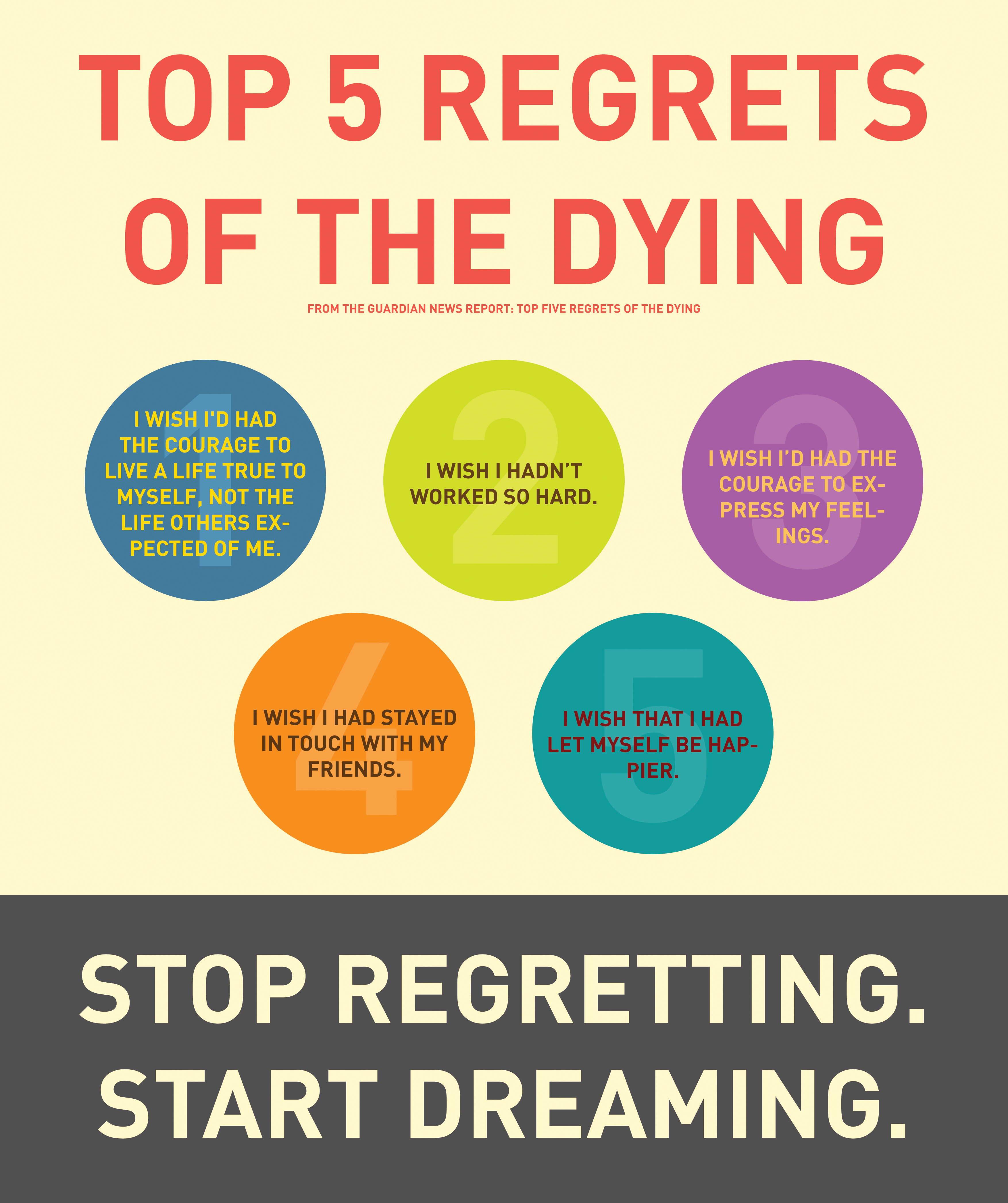
Top 5 Regrets of the Dying

Teo Yu Siang's avatarJust Random Designs

Stop regretting, start dreaming!

(Variant of a poster design I’d done for Regrets for Dreams; based on a news report from The Guardian)

View original post

Posted in Uncategorized | Leave a comment

Kagan: “How to Live Given the Certainty of Death”


Professor Shelly Kagan teaches a Yale philosophy course entitled “Death.” In this class session (available on the Open Yale Courses website), Kagan aims to answer the question: “Given the certainty of death, how should we live?” He lays out what he perceives as our options, drawing predominantly on a combination of logic and Western humanist philosophy.

Some of the lecture’s highlights:

  1. Three potential strategies for “pack[ing] as much as you can into life”: Settling for basic goals that are easy to attain, striving for accomplishments that are more valuable and harder to attain, or determining an appropriate balance of the two. (12:35)
  2. Longevity of life is important to an extent, but quality can trump quantity (Kagan experiments with a rectangular “area” calculation of life quality-points multiplied by life-years and determines it is an oversimplification—Quality is not quantifiable). (18:42)
  3. Two general philosophies for seeking out a semi/quasi/pseudo-immortality: believing the self lives on through works and accomplishments, and believing the self lives on through the natural recycling of bodily organic matter. (31:54)
  4. Mention of a more “Eastern” philosophy that life is not inherently good; when we let go of the notion that life is worth living, then we likewise let go of the difficulty of accepting death. (40:21)

Beneath these arguments, Kagan’s lecture carries home a central message: Mortality prompts choice. In the same way that deadlines motivate students to finish school projects or game timers stimulate sports stars to put their best foot forward, mortality moves us to meaningful action. We do not have a choice to opt in or out of being finite (at least on a physical level). But perhaps that is for the better—After all, as Kagan reminds us in his lecture, “Rich and incredible as the world is, eventually the goods of life would run out, and immortality would be dreadful.”

Life is made to be far more significant by the fact that it ends. It is awareness of this end that inevitably prompts us to make choices about the values, causes, desires, and beliefs that shape the limited time we do have, giving it true meaning. After all, it was contemplation of mortality (“Doesn’t everything die at last, and too soon?”) that prompted Mary Oliver to end her poem “The Summer Day” with a single, fearsome question that could perhaps be read as a more eloquent rephrasing of Kagan’s lecture title:

“Tell me, what is it you plan to do with your one wild and precious life?”


Posted in Uncategorized | Tagged , , , , , , , , , , , , | 1 Comment

Impressions of the Connecticut Hospice

On Friday afternoon, I rode a school bus to the Connecticut Hospice in Branford, battling a queasy stomach. I’m not one to get carsick (although it did happen to me once, about 10 years ago on a family vacation to the Grand Canyon). But this queasiness was not a matter of motion sickness; it was a psychological kind of unease. I knew I wanted to visit the hospice—but I couldn’t help picturing us (a group of about 70 bioethics students) tromping in like a group of grade-schoolers, peering into private rooms at what was obviously a private time in people’s lives. How could we take a “field trip” to a hospice without compromising the peace of its patients? The trip may have been bioethics-based, but I had my doubts about its morality.

New Image

Madeline Torres-Baird, Director of Social Work at the Connecticut Hospice, described the social work aspect of hospice care. Torres-Baird explained how her team assesses every family that comes in to see how they are coping with referral to hospice care, offers family and individual crisis counseling, and facilitates donations for patient care.

After about a 20-minute drive, we arrived at a place that looked approachable, even inviting: a gathering of grass lawns, fountains, large-windowed buildings, and doors that slid open into something like a hotel lobby. I noticed as we filed in that there was an empty ambulance parked quietly but conspicuously at the front curb, where we exited the bus. We climbed carpeted stairs—the kind you only ever see in people’s homes—and passed through hallways of framed artwork that varied in size and spoke calm colors into the room. Then we all lined up for oatmeal raisin cookies before being led into a large, dark room. The sensation of a childhood field trip crept up into my consciousness again, and it felt wrong. I worried about where they were going to take us next and whether it would be intrusive.

New Image 1

Sherra Stewart-Rego, Director of Nursing Fellowship at the Connecticut Hospice, provided general information about the unique mission of hospice care and the manner in which the program’s different branches come together to provide holistic end-of-life care.

Then the mood of the visit, or at least my skepticism toward it, changed. The staff began to introduce themselves, played an informative video about the purpose of hospice, and gave the impression in every way that visitors were quite welcome. Without setting foot in any private patient space, they led us out to a sprawling park with sloping grass hills and trees rooted right at the edge of the seaside. Waves stirred softly behind us as we all seated ourselves around a white balcony in the sunshine, and the hospice staff stood as a team at the opening of the balcony to explain their mission in more detail. Here are some of the key quotes from their opening descriptions that I think really embody the work they do:

New Image 6

Dr. Joseph Andrews, Medical Director of the Connecticut Hospice, emphasized the importance of supporting patients at the end of life through extensive palliative care. Notably, Andrews stated that although euthenasia and physician-assisted suicide are often hot topics for debate, “If palliative care is provided well and patient care is managed, then those issues won’t even come up.”

“As hospice members, it is not our purpose to change the family. It is our purpose to meet the family where they are.”

“Right from the beginning we have an idea of the needs of our patients, from physical needs to psychological needs, and whenever there is a subtle change our team can step in.”

“In no setting that I’ve ever worked in the hospital do patients have as much access to everything they need.”

New Image 3

Katherine Blossom, Director of Arts at the Connecticut Hospice, related the importance of the art therapy program in helping patients and their families to process thoughts and emotions, explaining that art “helps patients to tell their unique stories” and to “bolster the effects of the pharmacy.” She went on to state that “the autonomy of our patients becomes eroded bit by bit” as they near the end of life, but that “creativity is a sort of life force, and it also presents the ability to make choices.”

The staff members went on to describe the many and varied aspects of care offered to patients during and after their stay: medical support, social work, spiritual counseling, art therapy, and bereavement. Seamless complements to one another, each member of the team spoke their part, describing their particular facet of care with unmistakable sincerity and passion. The more I heard about their mission and the details of their services, the more I realized how many different aspects of a patient’s life hospice care seeks to address in what is often such a short (but significant) span of time. And as impressive as this approach was to me, it also, more simply, just seemed intuitively right. Patients’ needs at the end of life can vary enormously. Although the central component and founding principle of hospice is the medical care it offers, patients (no matter how near or far they are from their expected prognosis) are not reducible to the medical conditions they face—far more complex than that, they are human beings who have histories and families and multifaceted lives that call for multifaceted care.

Even in the way they treated us as visitors, welcoming us with warm
handshakes and cookies and an ocean view, it became clear to me during our visit that the staff of the Connecticut Hospice cares about all the small things that, together, truly make a person feel cared-for. I can only imagine how well that kind of thoughtfulness translates into end-of-life patient care.

For more information on the Connecticut Hospice, visit their website at http://www.hospice.com

Posted in Uncategorized | Tagged , , , , , , , , , , , , | 2 Comments

Matters of Interpretation

The instructions at the beginning of our first “End-of-Life Issues” seminar were left open to interpretation: “Draw your conception of the end of life—anything that comes to mind, abstract or concrete. No words. Simply use symbols and colors in any way you wish. You can represent places, people, ideas, memories, beliefs, feelings—anything that conveys your experience and perspective.” We weren’t told anything about the mandala’s purpose other than Evie Lindemann’s vague statement that “for some of you, this will be a fun activity, and for others it might be a bit uncomfortable—but I can promise that by the end you’ll be glad you did it and you’ll wish it never ended.” Some skeptical chuckles surfaced in response, but soon the room was silent aside from the scratchings and clickings of chalk traveling from plastic box to paper image.

The end of life? I started a scratch-paper list in an attempt to float some of my swimming thoughts: cross. family tree. mom highlighted. The ideas seemed too simple. I couldn’t picture a complete drawing, but I looked around, and it didn’t seem like anyone else knew where to start with theirs, either—lots of hovering hands and hovering eyebrows just waiting for ideas to come. I stopped thinking and started drawing. Blue circles and lines, yellow glows, a red arrow here, a black truck there. Three simple brown lines as small, flattened bodies. What does cancer look like in chalk? What color is loss? Acknowledgement of repressed feelings came out as multi-colored squiggles behind a closed, wooden door. Everything was superimposed on the quiet image of a gray cross. A few more minutes passed, and we taped our drawings up to make a gallery of the right and left walls of the lecture room, then gave a few minutes’ explanation of our drawings to the group.

The idea of diverse perspective always sounds cliché. It’s become an intangible ideal for the liberal-minded in modern times. But actual immersion in diversity of perspective is honestly enthralling in a different way every time it happens. It was a singular experience to be able to speak so openly about end-of-life beliefs and experiences with people I had hardly met the day before (In fact, I still hadn’t met many of them) and to see the diverse array of interpretations—not only of the matters of life and death we were discussing, but of the instructions to the assignment itself. Some students drew neat, concrete shapes; others, sloping shades of abstract color. Some students wrestled angrily with world politics at the root of fatal injustice, and others reflected with a dignified calm on cultural values that had shaped their understanding of the infinite. But even with all of the unpredictable twists and turns of plot that came to characterize our collective class narrative, what I observed to be the most interesting pattern was the appearance of a general unifying theme among all of our presentations. Although the assignment was supposed to be centered on the end of life, none of us had been able to separate our conceptions of the end from the experience of life itself. Each student’s presentation, at least to some degree, explored not an isolated set of ideas about life’s end, but a cohesive chain of past, present, and postmortem unique to their experiences. I realized in that moment, more than ever, how much life experience shapes conceptions of death. And what I would argue is truly the most beautiful part of that process is the free will we all possess to interpret those formative experiences.

Image

Posted in Uncategorized | Tagged , , , , , , , | Leave a comment

The Forgotten State of the Finite

Monday morning, I had the privilege of hearing Dr. Daniel Callahan give a lecture on the current American healthcare system and his suggested model for change.

Photo of Daniel Callahan

Photo of Daniel Callahan (Photo credit: Wikipedia)

I won’t share my own under-construction opinions on healthcare models or healthcare rationing (although I do agree with Callahan that we will inevitably face some kind of healthcare rationing in the near future.) But the point from Callahan’s lecture that I’d like to discuss in depth is more philosophical than political: that we as human beings must recognize the notion of a finite lifespan. What does that look like in the context of health care? Central to Callahan’s argument is the idea that American medicine is chasing an unrealistic ideal of endless progress. The cultural norm for a sick patient has become an endless fight against death—tooth and nail, syringe by pill bottle to the bitter end. Aided by the incredible technological advances of our time, we have steeped ourselves into a state of denial. We have made a moral practice of prolonging death for as long as possible, until we’ve come to see healthy life as a natural entitlement and death as an unsightly enemy. In the words of Faith T. Fitzgerald in her 1994 New England Journal of Medicine article, “The Tyranny of Health,”  “…if one accepts the idea that physical vigor and emotional and social contentment are not only desirable, but also expected, there is a problem. If health is normal, then sickness and accidents are faults…We now act as if we really believe that disease, aging, and death are unnatural acts and all things are remediable. All we have to do, we think, is know enough (or spend enough), and disease and death can be prevented or fixed.”

But death is absolutely natural—Remember? The stuff we are made of, all the fleshy stuff at least, is not impenetrable stone or un-decay-able steel. And even then, crack open a chemistry book: stone erodes, and steel corrodes. Nothing that lives is permanent or perfectly resilient (except maybe that species of cockroaches that survived Hiroshima.) In fact, as Atule Gawande sets out to show in his 2007 New Yorker article “The Way We Age Now,” death is not only a natural process; it is far more natural than the modern state of human aging: “…for most of our hundred-thousand-year existence—all but the past couple of hundred years—the average life span of human beings has been thirty years or less. (Research suggests that subjects of the Roman Empire had an average life expectancy of twenty-eight years.) Today, the average life-span in developed countries is almost eighty years…We are, in a way, freaks living well beyond our appointed time. So when we study aging what we are trying to understand is not so much a natural process as an unnatural one.” While making natural death out as a monster, we have stretched lifespans to longer and longer limits, often compromising quality of life drastically for the sake of prolonged, invasive medical treatment.

When confronted with the question of how our culture can be shifted to accept the concept of a finite lifespan, Callahan himself admitted that his ideas were idealistic, perhaps even utopian. In a suggestion that I considered his strongest, he proposed a shift in medical education, encouraging health care providers to focus on keeping patients happier and healthier rather than on keeping them alive as long as possible. Although the conclusion to Fitzgerald’s essay is hardly more specific or concrete in its propositions for effecting change, it rose to my mind as a natural note of harmony to Callahan’s proposal for a shift in public perception: “We cannot fix everything (though we do some things marvelously well), nor can our patients—no matter how intelligent or attentive—prevent all disease and death. We may be trying to do too much and thus diluting an awareness and application of what we can do well.”

Summary—American health culture’s To-Do List:

  1. Recognize that medical progress is finite.
  2. Recognize that the human lifespan is finite.
  3. Help a greater number of people to live healthier, higher-quality lives, regardless of lifespan.
Posted in Uncategorized | Tagged , , , , | Leave a comment

An Opening Disclaimer

I thought it appropriate for my first post in this blog to write a brief disclaimer. I do not pretend to have any official or trained experience in the field of end-of-life issues. I am an undergraduate student, a rising junior to be exact, studying English. I am not a doctor or a philosopher. I am not even a student of medicine or philosophy (on any transcript, that is). I can say, however—at least for this summer—that I am a student of bioethics. For the first time, I will be studying and discussing bioethics in a formal academic setting, as a member of the 2013 Yale Summer Bioethics Institute, and this blog will serve as an accompanying project to my experience in that program. While maintaining an appropriately solemn approach to this blog’s topic, I intend to collect, examine, and reflect on information associated with end-of-life issues drawing on current events, the opinions of my peers and educators at the bioethics institute, artistic representations of the end of life, and ideally many other resources as a guide and database for my studies.

With a promise to conduct thorough and careful research, I conclude with confidence in my professional/academic inexperience and with the posing of three questions, which found themselves not on my lack of professional or academic experience, but on the simpler, less quantifiable experience we all share as members of humanity: With all due respect to doctors and philosophers (who are generally quite skilled and experienced in their fields) are we not all lifelong students and professionals of medicine and philosophy? What is the study and practice of medicine but the act of understanding the body and maintaining a healthy life? What is the study and practice of philosophy but the quiet thoughts that creep into the mind (that place of such odd solitude!) and cause us to question the meaning of the life we maintain—the life which, at some point for all, will come to an end?

Posted in Uncategorized | Tagged , | Leave a comment